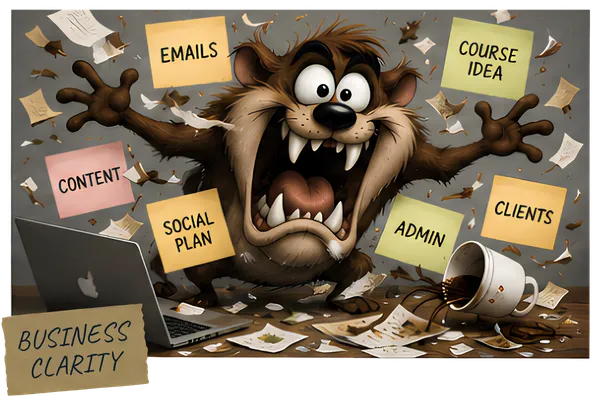
Why Your Business Still Feels Chaotic Even Though You're Working Constantly
Why Your Business Still Feels Chaotic Even Though You're Working Constantly
You start the day with a plan.
You know what needs to be done. You have a list. Maybe even several lists.
Then the emails start.
A client has a question. A team member needs a decision. A lead comes through. A task you've been avoiding suddenly feels urgent.
Before you know it, it's 5pm and you've been busy all day but somehow the important work still hasn't happened.
Sound familiar?
The frustrating part is that most business owners assume the problem is that they need to work harder, become more disciplined, or find another productivity tool.
But in most cases, the problem isn't effort.
It's chaos.
And chaos doesn't disappear simply because you're working more hours.
Busy and productive are not the same thing
Many business owners spend years trapped in a cycle of constant activity.
They're answering messages, putting out fires, attending meetings, chasing overdue tasks, and solving the same problems repeatedly.
From the outside, it looks productive.
From the inside, it feels exhausting.
The reason is simple.
You're spending most of your time reacting instead of operating.
Every day becomes a series of interruptions rather than a system that moves your business forward.
Chaos is usually a systems problem
One of the biggest misconceptions in business is believing that chaos comes from growth.
It doesn't.
Chaos comes from growth without structure.
More clients.
More leads.
More projects.
More team members.
More moving parts.
Without clear systems, every new opportunity creates more complexity.
What worked when you had a handful of clients quickly becomes unsustainable as your business expands.
The spreadsheets multiply.
The sticky notes pile up.
The inbox becomes your task manager.
And suddenly everything feels harder than it should.
The hidden cost of keeping everything in your head
Many business owners are carrying an invisible workload that nobody else can see.
They're the only person who knows:
Where information is stored
How tasks should be completed
Which client needs what
What happens next in every project
How all the moving parts connect
At first, this feels efficient.
After all, it's faster to do it yourself.
But eventually your brain becomes the operating system of the business.
And that's where things start breaking down.
Because no matter how capable you are, your memory is not a scalable business strategy.
Why working harder isn't fixing it
If you're constantly working but still feeling overwhelmed, it's worth asking a different question.
Instead of:
"How can I get more done?"
Ask:
"What keeps creating the same problems?"
When you find yourself repeating tasks, answering the same questions, searching for information, following up manually, or fixing avoidable mistakes, you're not dealing with a productivity issue.
You're dealing with a process issue.
And no amount of extra effort will permanently solve a process problem.
What a calmer business actually looks like
A well-run business doesn't mean everything is perfect.
It means things don't fall apart when you're busy.
Clients know what happens next.
Your team knows what they're responsible for.
Tasks are tracked.
Processes are documented.
Information is easy to find.
Automation handles the repetitive work.
Instead of relying on memory, everything runs through systems.
The result isn't just more efficiency.
It's more mental space.
You stop carrying the weight of remembering everything.
You spend less time reacting.
And you finally have room to focus on the work that actually grows the business.
Start small
If your business feels chaotic right now, don't try to fix everything at once.
Choose one area that creates the most frustration.
Maybe it's onboarding clients.
Maybe it's lead management.
Maybe it's project delivery.
Maybe it's communication with your team.
Document the process.
Simplify the steps.
Identify what can be automated.
Create a system that removes decisions and reduces confusion.
Then repeat.
Because sustainable growth doesn't come from working harder.
It comes from building a business that doesn't rely on you to hold everything together.
And when that happens, the chaos starts to disappear.
Not because you're doing more.
But because your business finally has the structure to support the growth you've worked so hard to create.